CCS vs CHAdeMO vs Type 2: EV connector types explained
If you're new to electric driving, one of the first things that can catch you off guard is the realisation that EV charging isn't as simple as one universal plug. Different chargers use different connectors, different cars have different inlets, and not everything is compatible with everything else. The good news is that the picture is much simpler than it first appears - and this guide will walk you through everything you need to know without the jargon.
By the end, you'll know exactly which connectors are in your car, which public chargers you can use, and how to find the right ones wherever you are in the UK using Electroverse.
First: AC vs DC charging - the essential distinction
Before getting into connectors, it helps to understand why there are different connector types in the first place. It comes down to the type of electrical current being delivered.
AC (alternating current)
This is the type of electricity that comes from the mains grid. Home charging points and most public slow and fast chargers deliver AC. Your car's onboard charger converts that AC into DC to fill the battery. The speed is limited by how powerful your car's onboard charger is - typically 7kW for home use, up to 22kW at some public AC posts.
DC (direct current)
This is what your battery actually stores. DC rapid chargers bypass your car's onboard charger entirely and deliver electricity straight to the battery at much higher power - 50kW, 150kW, 350kW and above. Because DC goes direct, it's dramatically faster, which is why all rapid and ultra-rapid chargers use it.
The reason you need to know this: AC and DC use different connectors. And some cars have a separate physical inlet for each.
Type 2 (Mennekes): the AC charging standard
What it looks like: A seven-pin plug with a flat top edge and a rounded bottom. Often described as shaped like a D, but with a small flat cut off the top.
What it's used for: AC charging - at home wallboxes, office chargers, slow public chargers (3-7kW), and faster public AC posts (up to 22kW).
Who uses it: Virtually every EV sold in the UK and Europe in recent years. Type 2 is the EU and UK standard for AC charging, mandated across public charging infrastructure since 2014. If you've bought a new EV in the UK at any point in the last several years - a Tesla, VW ID.4, Hyundai IONIQ 5, BMW i4, Kia EV6, Renault Megane E-Tech, MINI Electric, or any other mainstream model - your car has a Type 2 inlet.
What you need to know: Most home wallboxes and public AC chargers have a cable tethered (permanently attached) to the unit, so you just plug it in. At some public posts (known as "socketed" chargers), you'll need to bring your own Type 2 cable - most EVs come with one in the boot.
The Type 2 connector can handle single-phase AC (7kW, typical for homes) and three-phase AC (up to 22kW, found at some commercial and workplace chargers). Most UK homes only have single-phase power, so a home wallbox will max out at 7kW regardless of what the connector supports.
CCS (Combined Charging System): the rapid DC standard
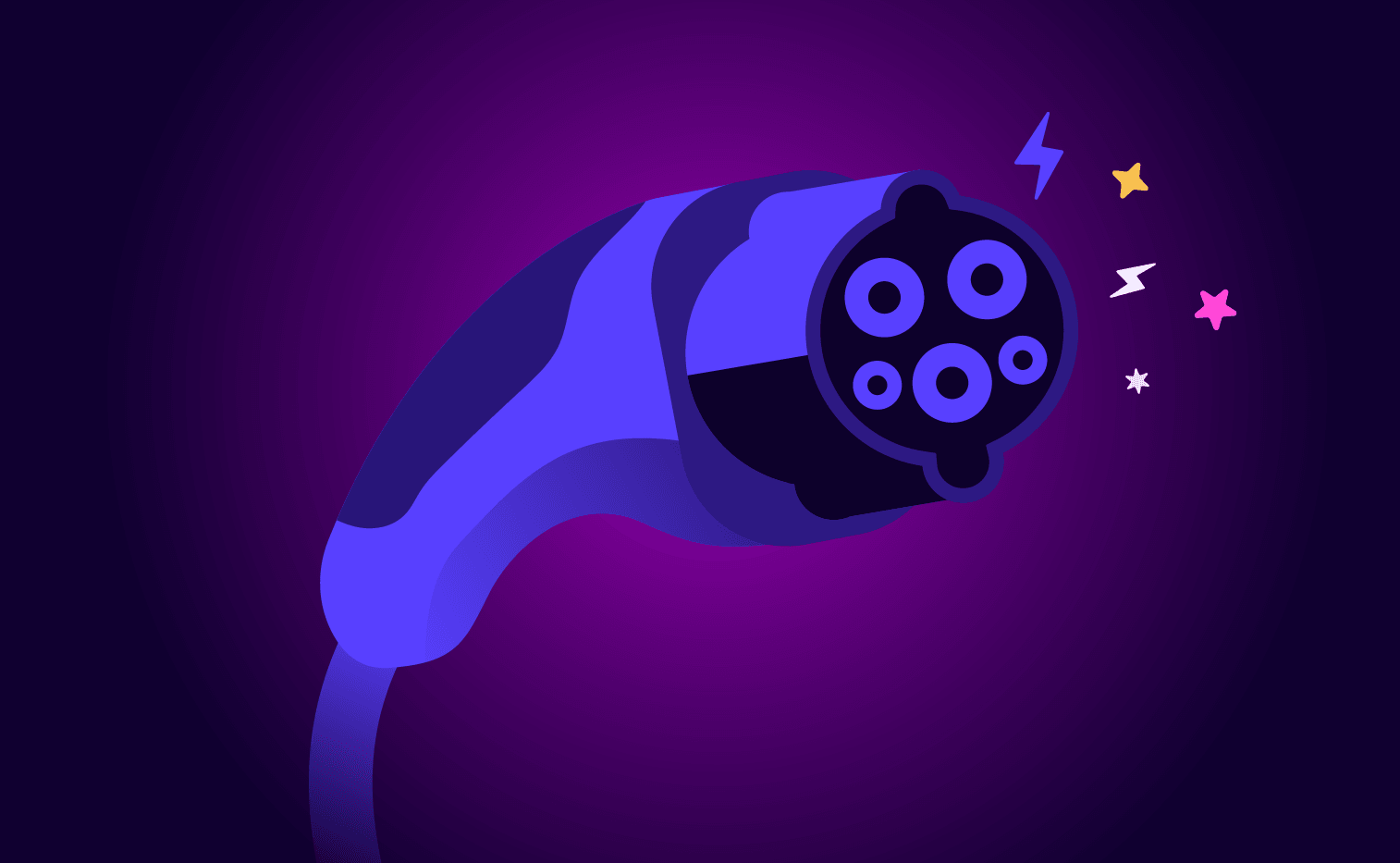
What it looks like: A CCS plug is essentially a Type 2 connector with two large additional DC pins attached below it. The connector is noticeably bigger than a Type 2 alone - it's the large plug you'll see at motorway charging hubs and rapid chargers.
What it's used for: Rapid and ultra-rapid DC charging - the fast en-route charging at motorway services, Osprey hubs, Ionity stations, and most of the rapid network across the UK.
Who uses it: The vast majority of EVs sold in the UK today. CCS has been the dominant DC charging standard in Europe since the EU mandated that all public DC chargers must include a CCS connector from 2017. The UK followed the same direction. Tesla, which previously used its own proprietary connector in some markets, now uses CCS for DC rapid charging at its UK Superchargers and on its vehicles in Britain.
What you need to know: If your car has a CCS inlet - which you can identify by checking whether there are two extra DC pins below the main charging port - you can use the full UK rapid and ultra-rapid network. The CCS standard supports charging up to 350kW commercially deployed (and over 500kW in lab demonstrations), making it future-proof for the foreseeable future.
Here's the clever bit: a CCS inlet on your car is actually a Type 2 inlet with the extra DC pins built in below. When you charge at home on AC, you plug a Type 2 cable into the upper part of the inlet - the lower DC section just sits empty. When you use a rapid charger, the full CCS connector engages both sections. You only need one inlet in your car to handle both AC home charging and DC rapid charging.
CHAdeMO: the declining DC standard
What it looks like: A large, round connector - noticeably bulkier and rounder than CCS, with a distinctive circular shape and a locking lever. If CCS looks purposeful and modern, CHAdeMO looks unmistakably like it comes from an earlier era.
What it's used for: DC rapid charging - but specifically for vehicles that have a CHAdeMO inlet rather than CCS. CHAdeMO can't be used with a CCS inlet or vice versa; they're entirely separate systems.
Who uses it: Predominantly older Nissan Leafs (the most common CHAdeMO vehicle in the UK) and some early Mitsubishi models including the older Outlander PHEV. Notably, Nissan's own subsequent models - the Ariya SUV and the upcoming third-generation Leaf - use CCS. Even the next-generation Leaf, expected around 2026, is confirmed to be ditching CHAdeMO for CCS.
The dual-socket situation: If your car uses CHAdeMO for DC rapid charging, it will also have a separate Type 2 socket for AC charging - because unlike CCS, CHAdeMO doesn't integrate AC charging into the same connector. So CHAdeMO cars have two separate charging inlets: one for home/slow AC charging (Type 2), one for rapid DC charging (CHAdeMO). CCS cars have just one combined inlet for both.
What you need to know: CHAdeMO is a declining standard in the UK and Europe. CHAdeMO now represents less than 30% of connectors across European charging networks and less than 15% of newly installed fast chargers. Major networks have stopped installing CHAdeMO at new locations, citing low usage as newer EVs standardise on CCS.
For current Leaf owners, CHAdeMO chargers remain available at many sites - particularly on multi-standard chargers at motorway services that include both CCS and CHAdeMO heads - and there's no immediate crisis. But it's worth being aware that public CHAdeMO provision won't grow, and some networks are gradually reducing coverage.
Type 2
CCS
CHAdeMO
Current type
AC
DC
DC
Max speed
22kW (3-phase)
350kW+ commercially
100kW typical; up to 400kW (v2.0)
Typical UK use
Home / slow public
Rapid / ultra-rapid
Rapid (older vehicles)
Vehicles
Almost all modern UK EVs
Almost all modern UK EVs
Older Nissan Leaf, early Mitsubishi
Public network
All AC posts and home wallboxes
All rapid/ultra-rapid hubs
Reducing; available at multi-standard sites
Future direction
Standard; not changing
Growing, future-proof
Declining in UK/Europe
What about Tesla? And NACS?
Tesla needs a specific mention because its connector situation is slightly different from other manufacturers.
In the UK, Tesla vehicles use a Type 2 inlet for AC charging (exactly the same as other European EVs) and CCS for DC rapid charging. All Tesla Supercharger sites in the UK are CCS-compatible, which means non-Tesla EVs with CCS can use them- and Tesla drivers can use the wider CCS rapid network without needing any adapter.
In North America, Tesla developed its own connector (originally proprietary, now called NACS — North American Charging Standard), which has been adopted by most US and Canadian manufacturers. NACS is not used on UK or European Tesla vehicles, so you won't encounter it on British roads or chargers. If you're researching EVs or EV charging from US sources, NACS references don't apply to the UK market.
Can I use adapters to mix connector types?
For AC charging, there are adapters available - for instance, a Type 1-to-Type 2 adapter for older EVs with a Japanese-spec inlet. These are generally safe and work well for lower-power AC charging.
For DC rapid charging, the situation is more complicated. A widely available CCS-to-CHAdeMO adapter for public rapid charging remains frustratingly elusive for UK drivers. There is no simple, consumer-market adapter that lets a CHAdeMO car use a CCS charger or vice versa. The communication protocols between the two standards are fundamentally different, not just the physical connector shape.
The practical upshot: if your car uses CHAdeMO for rapid charging, you need to use CHAdeMO chargers. You can't plug it into a CCS-only rapid charger with an adapter. Plan your routes accordingly using the Electroverse map's connector filter.
What about the "3-pin" plug?
There's a fifth option you may have seen referenced: the ordinary household 3-pin plug (BS1363). Some EVs come with a "granny cable" - an adapter that lets you charge from a regular 13A socket. This delivers around 2.3kW, adding roughly 8-10 miles of range per hour. It's a useful emergency backup but not a practical regular charging method for most people. It's not recommended as a permanent home charging solution, and it's not used on any public charger.
How to filter by connector type in the Electroverse app
Once you know which connectors your car uses, the Electroverse map lets you filter so you only see compatible chargers - no scrolling through irrelevant options.
In the Electroverse app:
Open the map
Tap the filter icon
Under Connector type, select Type 2 for AC chargers, CCS for rapid and ultra-rapid, or CHAdeMO if relevant to your car
Set your preferred minimum speed if you want to narrow further
Real-time availability is shown for most chargers, so you can see not just whether a CCS charger exists at a location, but whether it's currently free.
Electroverse gives you access to over one million chargers across the world - including Osprey, Ionity, InstaVolt, bp pulse, MFG EV Power, and hundreds of others - all from a single account. One app, one card (the Electrocard), every major network.
The connector question in a nutshell
For the vast majority of EV drivers in the UK in 2026, the answer is simple:
Type 2 for home charging and public slow/fast chargers
CCS for rapid and ultra-rapid charging on the go
These two connectors, often combined into a single CCS inlet on modern EVs, cover essentially the entire UK public charging network. If you're buying a new or nearly new EV, CCS is standard and future-proof.
If you drive an older Nissan Leaf or early Mitsubishi with CHAdeMO, you still have access to a meaningful number of rapid chargers across the country - but it's worth planning journeys with connector availability in mind, as the CHAdeMO network is gradually contracting while CCS continues to grow.
Find compatible chargers near you
The Electroverse map lets you filter by connector type, speed, and live availability. Whether you drive a CCS or CHAdeMO vehicle, you can find compatible chargers anywhere in the UK - and pay for them with one account across every major network.
Feeling enlightened or do you think something was missing? Let us know by sharing your feedback.